Tuesday, February 26, 2013

Passenger Rail in New Hampshire


Since I was young, I've been traveling to New England to visit my uncle – and later his family – who lives in Nashua, N.H. My first train ride outside of Buffalo's Metro Rail light-rail line was on such a trip, as we headed down to Boston to tour the Freedom Trail and other historic places in downtown Boston. While we were there, we rode the MBTA's Blue Line subway. On a later vacation, my first commuter rail trip was on the MBTA's Lowell Line – the closest rail connection from Nashua to Boston. Later on, Amtrak's Lake Shore Limited took me and my aunt from the Buffalo-Depew station to Worchester on another visit and back home again – another first for me, marking my first intercity train experience. On other trips, we rode the Conway Scenic Railway and the Mount Washington Cog Railway in the state's north country region.

Suffice it to say, the passenger rail operations in New England were fundamental to my earliest interest in railroading. Each time I went, though, I asked my uncle and others why we couldn't just take the train right from Nashua to Boston? After all, I discovered fairly early on – via fold-up maps and gazetteers, the much more difficult precursor to today's internet mapping applications – that the same rail line that hosted the Lowell Line continued north, not only to Nashua but continuing on to the state's largest city of Manchester and it's capital, Concord. Indeed, just a few years before I began travelling to Nashua, the Boston & Maine Railroad still operated its Minute-Man trains on the route, offering multiple daily departures geared toward commuters and tourists (see timetable below).


After the Boston & Maine was acquired by Guilford Transportation in 1983, the service was curtailed from Concord to Lowell, as the MBTA acquired the route between there and Boston's North Station. From then until now, the line north of Lowell has only hosted Guilford – now known as Pan Am Railways – freight trains.

However, in recent weeks, significant momentum is emerging to restore passenger service on the route. On February 6, the New Hampshire Executive Council – which gives final executive approval to pressing state matters as a constitutional check on the governor's authority – voted to approve a $3.6 million feasibility study on resuming passenger rail operations.

While a study of a potential service hardly represents a firm decision to ultimately further the project, the Council's vote represents a significant shift in the state's attitude towards passenger rail. Just last year, the Council – then comprised of different members who either retired or were voted out of those positions in last November's elections – prevented the same feasibility study to move forward. Other passenger initiatives regarding the corridor – even an extension only as far as single station across the state line from Massachusetts in South Nashua – have never received committed state funding.

Just eight days later, the Nashua city board of aldermen approved a $1.4 million property purchase on Crown Street (see map below) where a new passenger rail station would be located. The local funds will be matched with $6.5 million in federal investment through the Congestion Management & Air Quality (CMAQ) program as well as $280,000 in highway toll credits through the state's Department of Transportation.


View Larger Map

The twin decisions demonstrate a new found interest and commitment by state and local leaders in New Hampshire to at least explore the possibility of passenger rail options in New Hampshire's most heavily-populated and economically important corridor.

Of course, the study's findings may yet convince those same leaders that the requisite levels of investment necessary to support service don't match the state's priorities, a reality Pan Am Railways President David Fink articulated quite reasonably in a recent editorial. An agreement with Pan Am would be paramount to the project, along with important decisions on station locations, service frequency, equipment and a service operator. None of these aspects will be arrived at quickly or inexpensively. Moreover, the state's longstanding resistance to developing passenger rail between Concord, Nashua and Lowell begs some substantial hesitancy.

Nonetheless, by agreeing to undertake a feasibility study and acquiring a potential station location, a foothold has been established for intercity and passenger rail through New Hampshire's Merrimack Valley for the first time in more than 30 years.

Tuesday, February 19, 2013

Guest Post: Trainsforming America

We're please to offer the first guest post at the Potomac Express, authored by Rebecca A. Sansom, the co-producer of a new documentary on the promise and potential of high-speed and intercity rail in the United States called Trainsforming America (Twitter: @trainsformingus) We asked Rebecca to share some of the broad themes of the film, which outline the import of renewed investment in passenger rail – not only in sweeping policy implications but also in a very real personal context. Stay tuned here, our @RAILMag Twitter handle and future editions of RAIL Magazine for further coverage of Trainsforming America!


Eve is in her seventies and lives in Deal, England. Her children live in London. She enjoys living near the train station because she doesn't want to drive into the city anymore.

Ana is terrified of flying, but has to travel from London to Madrid about 4 times a year. She opts for the overnight train to ease her anxiety.
     
The Martins live in Grants Pass, Oregon which is similar in size to Deal, England. They tend to drive everywhere, but wish there were more transit options like there are in Portland.

Giuliano Scarsi wishes he felt safe walking in Nashville, TN when he comes to visit his wife's family, but notes, “There are no sidewalks!”


Clearly there is a cultural difference when it comes to transportation here versus abroad. The aim of this film is not to demonize our car culture, but to continue the conversation about our pressing infrastructure needs. Our population is growing at a rate that is not going to make it very pleasant for every American to own their own automobile. As Stanford Professor, Anne Ehrlich, notes in the film, “Having a 120-lb. person driving a 4,000-lb vehicle to get the groceries doesn't make a lot of sense.”

America needs to lead by example when it comes to climate change solutions. Investing in more passenger rail and building the California High-Speed Rail network will show the rest of the world that we care about our children and grandchildren's futures enough to evolve.

We let our passenger railroads deteriorate, and now our roads and bridges are falling apart, too. What should we do? Do American passengers want more and more people to drive on our already-congested highways? Or, do they want the option to ride?

We don't think history will remember the Marco Rubio's of the current political system, who say there is no point in doing anything unless everybody does something. History will remember the leaders that tried to make America a healthier and easier place to, simply, live. People like Bernie Sanders and Barbara Boxer, who tried to pass the Global Warming Pollution Reduction Act of 2007.

In fact, it seems that climate change deniers are fine preaching Big Oil's tired diatribe that climate change is not a threat when other countries are actually doing something. Are we really going to let China surpass us on energy solutions like they already have in high-speed rail technology?

Why can't we commit to a robust, noble message about climate change? Why can't we take steps to advance by investing in passenger rail? I mean, honestly, the worst that could happen is we'll have cleaner air and less stressed-out commuters.

After making this film, we believe that the current public support for more sustainable and efficient transportation options will result in a successful attempt to pass progressive legislation concerning rail.

To quote President Obama in his 2013 State of the Union Address, we need to “act before it is too late.” The Forward on Climate rally was successful in exposing the dangers of the Keystone XL pipeline.  Rallies like that are necessary to turn our government's silence on climate change into action, and we hope films like ours will continue to further that aim.

As far as where you can see the film, at this point we're trying our luck at the film festival circuit. It would be nice to have a distributor acquire the film, but to do that we need help from other rail enthusiasts to get the word out and garner support for its release. If you would like to purchase a license to screen the film for educational purposes, please send us a message. Check the website for upcoming screenings.

Together, we are Trainsforming America! 

Friday, January 25, 2013

One Rail to Unite the World?


One of the last topics some of you might expect to be covered here is the Obama Administration's forthcoming decision on the Keystone Pipeline, that would carry oil from oil sands deposits in Alberta to locations in the United States. This post isn't to discuss the benefits and disadvantages of that decision (which are many), but rather to explore the ramifications on North American rail infrastructure if it is denied by the Administration.

If the pipeline is not constructed, there might be significant momentum to build a new rail line from Fort McMurray, Alberta to Delta Junction, Alaska to transport that same oil that was to be moved by the pipeline. The project – proposed by a collaboration of several First Nations (counterparts in Canada to American Indian tribes in the United States) – would construct a new railroad from existing rail lines in Fort McMurray through extremely remote and mountainous terrain in Alberta, British Columbia, the Northwest Territory and Alaska to reach the Trans-Alaska Pipeline System (TAPS) at Delta Junction.


Surely, you're asking yourself, "wait, isn't this blog about passenger rail?" Well, certainly the primary objective of the new rail line would be to move large volumes of oil to the TAPS and worldwide oil market. But the project's backers were already undertaking such substantial effort, they would likely also built a connection with the Alaska Railroad in Fairbanks – about 95 miles north and west of Delta Junction – to expand the infrastructure's utility. In that event, the prospect of offering some form of passenger rail service from Alaska through Canada to the continental United States for the first time in history becomes an exciting prospect. Already, both the Alaska Railroad as well as private rail tour companies in western Canada offer passenger rail trips that attract riders through their journeys through remote and awe-inspiring landscapes. A rail travel experience that connects both could well find a healthy market of customers, let alone the potential to connect smaller on-line communities with scheduled intercity travel.

Of course, such an endeavor would require copious capital derived from both public and private sources – likely upwards of $100 billion – but also in-depth study of the feasibility of the freight oil operation and whether the revenue produced would come anywhere close to the operational and capital costs associated with the project. At the same time, such a rail line could also carry other commodities to support its operating costs.

The real point of spending a whole blog post on this subject, though, isn't just exploring the concept of an Alberta – Alaska rail line, however far-fetched, but taking the idea to its most extreme conclusion: if a new rail line is already being constructed on such a scale, why not just go full-bore and continue the line due west to travel through a sub-Bering tunnel to reach Russia?


The idea is so unlikely it borders on absurdity, but let's have at it, briefly. Since the Alaskan wilderness became America's last frontier in the 19th century and as the Channel Tunnel – also known as the Chunnel or Eurotunnel – linked England and France by rail in 1994, high-minded dreamers have floated the notion of connecting Alaska and the easternmost stretches of the world's largest geographical nation by a rail span. And although there's glacial-sized challenges to such a project, one of the chief obstacles is that no rail network exists outside of Alaska to connect the crossing with the American and Canadian mainland. Such a massive undertaking could not be justified without linking to both the population and industry centers of Asia, Europe and North America, and the Alberta – Alaska segment would be the most challenging aspect to construct besides the tunnel itself.

At the same time, Russia is already extending its railway network to Yakutsk – the most northeastern reach rails have ever realized – and has approved plans to ultimately continue the route to the Bering Strait as well as supporting a sub-Bering tunnel to Alaska. It should be noted that the level of investment and political will necessary to drive the project in Russia is unsubstantiated.

On the American side, late former Alaska Governor Wally Hickel championed the idea during two terms as the state's top elected official and remained a supporter until his death in 2010. Other state and local leaders in Alaska have discussed the concept, but no plans have ever moved beyond the drawing board.

So, until projects in the United States, Canada and Russia to link the two continents with what would be among the most complex and challenging infrastructure projects in world history, we're left to ponder could someday be a train trip boarding in London and terminating in New York, with stops en-route in places ranging from Warsaw to Winnipeg? What about a Pacific Rim Flyer, originating in Shanghai and arriving in Los Angles or San Diego? Maybe the Cold War Comet express service between Moscow and Washington, D.C.? How about a twin peninsulas route starting in Miami and concluding in Rome? The permutations of globetrotting routes could yield months of daydreams for any rail enthusiast.


By linking much of the world via the same standard gauge rail network could mark a new level of human connectivity and foster new relationships between communities. It's a fascinating idea to consider, especially on days like today's wintry conditions here in Washington, D.C, where a winter ride through Alaska's mountain valleys and Siberia's frozen tundra doesn't seem that hard to fathom...

Monday, December 31, 2012

Looking Forward to 2013

Although its not quite the new year yet, RAIL Magazine and your blogger are already making some resolutions for 2013. You'll hear more about these in detail over the coming days and week, but a few we can talk about now are a renewed focus to deliver at least one new Potomac Express post each month, and a return to a regular schedule for publishing our Fast Mail for RAIL e-newsletter. New posts here will also provide sneak-previews of upcoming editions of RAIL, along with more well-designated call-outs to relevant content from past issues of RAIL. And, as always, stay tuned to @RAILMag on Twitter for up-to-the-minute passenger rail news.

In that spirit of welcoming some exciting developments for the year ahead, he's some of the projects and stories in North American passenger rail we're looking forward to covering in 2013, after 2012 offered some fantastic achievements, such as expansion of Amtrak service to Brunswick, Maine and Norfolk, Va., extended FrontRunner regional rail service in Utah connecting Ogden, Salt Lake City and Provo and strong support from voters for new streetcar systems in Los Angeles and Kansas City, among much more. We'll count down our top ten in reverse order:

10) Inauguration of X Train Service Between Southern California and Las Vegas

Source: Las Vegas Railway Express
The new luxury passenger rail service between Las Vegas and Southern California is targeted to begin operation in late 2013. Las Vegas Railway Express – the private entity which will own the service – negotiated agreements with Union Pacific this past November to operate over their rails between Las Vegas and Daggett, California. The service may connect with Amtrak Surfliner and Metrolink commuter rail trains in Fullerton, linking the operation with the region's existing passenger rail network.   The initiation of scheduled passenger rail service between Southern California and Las Vegas – which would be the first since Amtrak's Desert Wind was discontinued in 1997 – could build momentum for approval of high-speed rail infrastructure in the corridor via the XpressWest project.

Relevant RAIL Coverage: Only in Las Vegas (RAIL #22)

9) MBTA Service to Cape Cod

Source: Boston Globe
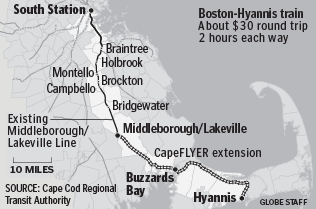
Another project to emerge late in 2012 is the resumption of passenger rail service from Boston to Cape Cod. Through the leadership of Massachusetts Governor Deval Patrick's administration and the Cape Cod Regional Transit Authority, Massachusetts Bay Transportation Authority (MBTA) commuter rail trains will be extended on weekends between Memorial Day and Labor Day from their current terminus at Middleborough/Lakeville over the Cape Cod Central Railroad and serve Buzzards Bay and the Hyannis Transportation Center, which offers connections to local and intercity bus routes. Fares are expected to run $30 each way and cover the cost of operations.

Relevant RAIL Coverage: RAIL #8

8) Development of the Phoenix - Tucson Corridor

Source: Arizona Department of Transportation
As Utah and New Mexico have now completed their efforts to link their largest population centers with regional rail systems – the aforementioned FrontRunner in Utah and New Mexico's Rail Runner Express between Santa Fe, Albuquerque and Belen – could Arizona be feeling left behind its regional counterparts? Plans appear to be moving quickly to link Phoenix and Tucson with the type of high-frequency rail service enjoyed by their southwest and mountain west neighbors. With Phoenix rapidly expanding its Valley Metro light-rail network and Tucson set to open its Sun Link streetcar later this year, the region is already primed for enhanced rail connectivity. Initial plans also suggest a multi-route commuter rail system in and around Phoenix as part of the effort.

Relevant RAIL Coverage: Leading from the Front (RAIL #28); Commuter Rail's Next Frontier (RAIL #30)

7) Higher Speeds on the NEC

Source: Amtrak
One of the less visible aspects of the investment in high-speed and intercity passenger rail that came out of the American Recovery and Reinvestment Act (ARRA) of 2009 has been the gradual upgrade of conditions on Amtrak's signature corridor, the Northeast Corridor (NEC). The corridor initially was one of the largest recipients of that funding, which has only grown after projects in Florida, Ohio and Wisconsin were cancelled. Although the failure of those initiatives – and the continuation of California's high-speed rail project – have received the bulk of the coverage on high-speed rail in the U.S., Amtrak has been steadily rebuilding the highest volume and highest speed passenger rail corridor in the western hemisphere over the past decade (read my assessment of the NEC here). Last fall, the railroad tested its Acela Express trainsets at speeds up to 160 mph on improved stretches of track in Maryland and New Jersey, besting its own top speeds previously achieved on short segments in Massachusetts and Rhode Island. These incremental increases will reduce trip times as Amtrak adds additional Acela and Regional frequencies to meet demand on the corridor that is already carrying capacity loads. Moreover, the railroad recently announced plans to acquire new, next-generation high-speed rail equipment by the middle of the next decade, in advance of its proposals to introduce parallel infrastructure over the next half-century to achieve true high-speed status.

6) Passenger Rail in North Carolina

Source: Triangle Transit
Many states have been proactive leaders in supporting passenger rail in their states over the past several decades. California, Illinois, Oregon, Washington and Virginia all come to mind, and this topic will receive more extensive coverage in an upcoming post here. But few have done so as unassumingly as North Carolina. The state has been one of the most steady supporters of intra-state Amtrak service, boosting reliability and frequency by improving infrastructure while also restoring a handsome portfolio of historic passenger stations. At the same time, Charlotte's LYNX light rail has received its fair share of press for its rail-oriented development projects as ridership has grown and new extensions move forward. In the coming year, look for more developments in the Tarheel State, as former Charlotte Mayor Pat McCrory becomes governor. McCrory has been a vocal advocate of transit, transit-oriented development and livable communities, which should set the stage for continued improvement of state-supported intercity rail in the Raleigh-Durham - Charlotte corridor, along with the creation of a new union station in Raleigh, local rail transit in the Triangle Region and new streetcar, light rail and commuter rail lines in Charlotte.

Relevant RAIL Coverage: Charlotte LYNX – A Rail History Lesson (RAIL #22); RAIL #5

5) Intercity Rail in the Midwest


Source: Kalamazoo Gazette
In the waning days of 2012, rail advocates celebrated the first test of a new higher-speed rail segment around Dwight, Illinois. The state is in the process of upgrading its Chicago – St. Louis corridor to achieve 110 mph speeds, which will allow for new frequencies, improved reliability and reduced trip times. Recent decisions by the Federal Railroad Administration will allow further work to continue on the corridor between Chicago and Joliet and through downtown Springfield. Elsewhere, the state of Michigan and Norfolk Southern move closer to a final agreement to transfer control of the Detroit –  Kalamazoo corridor to state ownership, which I covered extensively in this post. Meanwhile, Illinois continues to prepare for its launch of new service from Chicago to Moline and the Quad Cities in 2015, which may be extended to Iowa City and ultimately Omaha if elected officials in that Iowa approve investment to support its operations. At the same time, Indiana leaders must determine if they will support Amtrak's four-times weekly Hoosier State service between Chicago and Indianapolis, which is scheduled to be suspended later this year without state-level support. Other intercity routes in Missouri, Ohio and Wisconsin may see activity, along with efforts to extend the existing Heartland Flyer north from Oklahoma City, potentially connecting as far as Kansas City.

Relevant RAIL Coverage: Rising in the Midwest (RAIL #18); Iowa's Passenger Rail Experience...Continues (RAIL #14)

4) Northern Virginia's Silver Line Metro 


Source: Dulles Corridor Rail
One of the nation's largest rail transit projects is nearing completion of its first phase, as the new Silver Line of the Washington metropolitan region's Metro rail network plans extends service to five new stations in Tysons Corner and Reston in Fairfax County this coming December. Tysons Corner is one of the nation's largest business districts and will be served by four distinct stations, with neighboring Reston serving as the end of the 11.6-mile first phase until 2016, when another 11.5-mile extension reaches Herndon, Dulles International Airport and communities in Loudon County. In all, the Silver Line will add 11 new stations and 23 miles of new track to the region's existing 106-mile rail network, the second largest rail transit system in the nation in both passengers and mileage, after only the New York City Subway.

Relevant RAIL Coverage: RAIL #24 focus on rail-airport connections; Defined by Distinctiveness – Washington, D.C.'s Metro (RAIL #19)

3) All Aboard Florida


Source: All Aboard Florida
In under a year, the privately-supported All Aboard Florida effort through the Florida East Coast Railway (FEC) between the Orlando International Airport and downtown Miami has sprung from nothingness to a project nearing groundbreaking, construction and purchase of vehicles. I provided my assessment of the initiative earlier this year in this post. Just before the holidays, Florida officials approved negotiation with FEC to lease portions of the Beeline Highway between Cocoa and the airport to compliment FEC's existing rail line between Cocoa and Miami. Those negotiations should be completed this spring or summer, and construction is likely to begin on new passing sidings on the FEC route as well as stations at the airport, downtown Miami, West Palm Beach and Fort Lauderdale, along with the acquisition of locomotives and railcars.

Relevant RAIL Coverage: Two of a Kind – Miami's Metrorail & Metromover (RAIL #19)

2) Streetcars


Source: City of Cincinnati
2013 may prove to be a banner year for the development of new streetcar projects in the U.S. Until now, streetcar applications have been limited to modern systems in the Pacific Northwest (Seattle, Portland, Tacoma), historic-themed operations in the Southeast (Tampa, Memphis, Little Rock) and holdover networks (Boston, Philadelphia, San Francisco, Toronto). As mentioned above, Tucson's Sun Link will open later in 2013, marking the first modern streetcar service in the Southwest. On the horizon are routes currently under or nearing construction in Atlanta, Charlotte, Cincinnati, Dallas and St. Louis, and recent voter-approved systems in Kansas City and Los Angeles will transition from planning to engineering. The strategies and rationale used in these communities may likely embolden others to cultivate proposals into action.

Relevant RAIL Coverage: United Streetcar – Making it in America (RAIL #27); The North American Streetcar Overview (RAIL #26); The South Lake Union Streetcar (RAIL #22Revisioning the American Streetcar (RAIL #20); Connecting the Dots – Tampa's TECO Line Streetcar (RAIL #15)

1) Groundbreaking for California High-Speed Rail


Perhaps the most momentous occasion in passenger rail over the past half-century will occur this coming year in the California's Central Valley, when federal, state and local officials will gather to turn over ground for the first phase of construction for California's planned high-speed rail network. While much of the superficial coverage will focus on how the initial segment will be built in the state's less-populated agricultural corridor and won't reach either the Bay Area or Southern California for another decade, massive public infrastructure projects must begin somewhere and that's usually the place where it's easiest to accomplish. The nation's first interstate highway segment opened in rural Missouri and it took 13 Apollo missions to reach the moon. Patience is required for such a massive undertaking, one that could massively impact California's economy and communities for generations and centuries after its completed.

Relevant RAIL Coverage: The Grand Central Terminal of the West (RAIL #21)  RAIL #11

Sunday, March 25, 2012

Horizons of (High Speed) Rail Developing Everywhere

Late last year, we discussed the growing importance of the Detroit – Chicago Corridor in Michigan as a pragmatic advance in higher-speed passenger rail in the North America (read the full post here for details). Since that time, a few other developments have emerged that should boost the confidence of high-speed and intercity passenger rail proponents.


The more surprising news is Thursday's announcement by the owners of the Florida East Coast Railway (FEC) – Florida East Coast Industries (FECI) – that they plan to institute frequent passenger rail service between Miami and Orlando by 2014. The plan follows the messy 2010 abandonment of the publicly-funded Florida High Speed Rail project's initial phase between Tampa and Orlando, which we discussed at length here. That FECI is so eager in its attempt to resuscitate the scuttled intercity rail effort in its home state suggests that high-speed rail supporters' claims that private investment to support the earlier project would easily materialize was correct. As FECI's promotional materials for the project – which they dub All Aboard Florida – note, they believe there will be healthy returns on their investment supported by the operation of frequent and reliable passenger rail service between Florida's largest metropolitan regions.

FECI believes it will be able to meet its 2014 scheduled service launch because the trains will operate over FEC's main freight rail corridor, which stretches from Jacksonville to Miami. The railroad was constructed on the state's east coast in the 1880's and has been in continual service as a freight line since then (passenger service was discontinued in 1968). The All Aboard Florida effort would construct 40 miles of new railroad between Cocoa and Orlando to create a 240-mile passenger route that would make the trip in three hours at speeds reaching 110 mph and averaging 80 mph. According to project materials,  the service would operate with the high levels of frequency necessary to sustain demand for a vibrant intercity rail corridor and utilize conventional equipment, likely diesel locomotives hauling passenger coaches. Whether the rolling stock would be new or rehabilitated has not yet been released. Should the Miami – Orlando operation prove to be successful, FECI plans to expand the service to Tampa and Jacksonville, although details on those extensions are premature at this stage.

In addition to the positive operating revenues that are likely at the foundation of FECI's belief in the vitality of the project, additional nuances inherent in the FEC's modern operating environment make the effort even more understandable. Initially, the FEC is the first large railroad – either Class I or Class II, of which FEC is categorized as the latter – to fully utilize positive train control (PTC). FEC instituted PTC after a fatal 1987 collision. Already, the railroad operates its freight trains at speeds of up to 60 mph, among the highest in the industry. As a result, allowing passenger trains operating over the non-PTC speed limit of 79 mph is already possible on the line. Additionally, the FEC has likely realized the full freight potential of its railroad, with recently-completed cargo port facilities in South Florida representing the largest mechanism to grow freight traffic on the corridor. Accordingly, integrating passenger service into its portfolio of revenue-producing products marks an additional opportunity to utilize the full capacity of the railroad. Lastly, FECI is already well-staged to benefit from the developments fueled by a thriving intercity passenger rail operation, as the entity already has land development enterprises established to maximize the value of the land of and around its rail line. Having that organizational capability already established leaves FECI in a prime position to deploy rail-oriented development around the operation's stations.


Less a shocking development – but no less important, and perhaps much more so – is the turn-around in progress on California's High-Speed Rail network. Although the project has already lined-up far greater investment – $2.25 billion in federal funds through the American Recovery and Reinvestment Act and $9.95 billion from state proposition 1A in 2008 – much of 2011 saw misgivings at best and backlash at worst towards the initiative, which would connect San Francisco to Los Angeles with new, world-class high-speed rail infrastructure at speeds up to 220 mph and a trip time of 2 and 1/2 hours. Additional branches would expand the system to Sacramento and San Diego.

The turn of favor against the project was fueled, in part, by the release last November of the project's Business Plan, which estimated project costs skyrocketing from $40 billion in 2008 to more than $90 billion. The Business Plan did correctly note, however, that it calculated that cost by expected rates of inflation by 2040, when the full network is scheduled for completion, as well as the costs of a longer timeframe. As those details emerged, high-speed rail opponents found new ammunition against the entire project, and threatened to abandon the entire effort. But, in his 2012 State of the State speech, Governor Jerry Brown reaffirmed his administration's commitment to the project and promised to conduct a thorough re-assessment of the plans in order to reduce costs and shorten the timeframe.

To that end, Brown appointed Dan Richard – a former member of the Board of Directors of the Bay Area Rapid Transit (BART) system – as Chairman of the California High-Speed Rail Authority, and tasked him with re-establishing the vitality of the project. In working with the State Legislature, local leaders and project officials, the Authority has been able to re-cast the project to include new improvements to existing passenger rail infrastructure in both the Northern and Southern California metropolitan regions while still commencing construction of high-speed infrastructure in the state's Central Valley. The shift is expected to satisfy enough of the political unrest surrounding the project to allow the Legislature to approve release of Proposition 1A funds, and will mark significant upgrades to commuter rail operations between San Francisco and San Jose on the Caltrain service – which will be electrified under the effort – and Metrolink's Antelope Valley route between Lancaster and Los Angeles. Both segments will be enhanced to support blended high-speed and commuter rail operations, although not necessarily allow the very high speeds or higher frequencies stipulated in the full high-speed rail plan due to two, rather than four-track infrastructure and other capacity upgrades.

Nonetheless, the pragmatic compromise is the right move for the project as a whole. A delay or abandonment of the effort would be a massive setback to high-speed rail efforts in the nation, while also exacerbating traffic congestion on California's highways and air facilities. As the project advances, it will serve as a test case for high-speed rail technology, as the millions of annual visitors to the state can witness a true high-speed operation in reality. In the meantime, commuters and travelers in California's largest metropolitan regions will benefit from greatly enhanced commuter rail service and tens of thousands of both permanent and temporary construction jobs will be created to build those segments and the high-speed route through the Central Valley.

In all, the projects in Michigan, Florida and California – along with more gradually-improving conventional corridors in Illinois, the Pacific Northwest and Southeast – provide concrete evidence that the demise of high-speed and intercity rail projects that many observers predicted only a few months ago were short-sighted.

*Some observant readers may have noticed the title of this post as a reference to the H.O.R.D.E. Festival – Horizons of Rock Developing Everywhere – an annual summertime rock tour in the 1990s created by Blues Traveler.

Thursday, February 9, 2012

Analysis of Passenger Rail Provisions in Surface Transportation Reauthorization

U.S. Capitol and Union Station (foreground)
Currently, both houses of Congress are working through the legislative process to reauthorize the nation's surface transportation legislation. The current legislation – the Safe, Affordable, Flexible, Efficient Transportation Act - A Legacy for Users (SAFETEA-LU) – was signed into law in August, 2005 by President George W. Bush, first expired on September 30, 2009, and has since been extended by Congress (with approval by Presidents Bush and Obama) numerous times. The current extension expires on March 31st.

If the current legislation is not extended at the end of March, it must be replaced with new legislation by that date that is approved by both houses of Congress and signed by the President, or the funding statutes that support much of the capital and operating costs of the nation's ground transportation network will disappear, causing significant impacts on that network. This post will not assess the likelihood of either passage of new legislation or another SAFETEA-LU extension, but rather analyze the various provisions that affect all forms of passenger rail in the respective bills under consideration in both the House of Representatives.

In both chambers, there are separate bills – introduced in the appropriate committees of each house – which, if passed, are then combined to form a single piece of surface transportation legislation: one formulating the policy directions of the legislation and another delivering the funding necessary to support the various programs and projects specified under the policy direction.

House of Representatives

In the House, H.R. 7 – the American Energy and Infrastructure Jobs Act of 2012 – was introduced on February 2 and referred to the Transportation and Infrastructure (T&I) Committee. It was the Republican leadership of that Committee that was most responsible for drafting the bill, considering amendments and steering it's approval to return to the full House for a vote. The T&I Committee approved the measure early last Friday (February 3).

Although the bill's public transportation title (Title II) largely maintains much of the same policy structure for programs that support passenger rail projects, there are a few important changes. Most rail transit capital projects are supported through the Section 5309 New Starts Grant program, which now allows the Secretary of Transportation to award Full Funding Grant Agreements (FFGAs) for projects of over $75 million that are "authorized for project development." SAFETEA-LU previously stipulated "final design and construction," which indicates the Secretary – and the subsequent Department of Transportation staff who assist the Secretary in project decision-making – may receive some leeway in awarding FFGAs to projects earlier in the planning, engineering and design process under the House's proposed language, potentially resulting in shorter project timelines and lower costs for the engineering process. This change also fits within the T&I Committee's stated goal of streamlining project delivery.

More significant are the differences in how the Secretary should determine the benefits of federal investment for the project. In SAFETEA-LU, after factoring in the planning and alternatives assessment procedures used in the project proposal, the Secretary was directed to consider a list of factors such as congestion relief, improved mobility, air and noise pollution, energy consumption and the costs of mitigation activities before evaluating benefits such as land use development, impact on existing infrastructure, mitigating suburban sprawl, access for transit dependent populations, overall transit and ridership growth. In the new criteria devised by the House, the Secretary would now be directed to analyze cost effectiveness, mobility benefits and enhanced connectivity, congestion relief, reductions in energy consumption and air pollution, economic development effects and private-sector contributions to the project. The result would be a simplified and also less rigid set of evaluation criteria for capital rail transit projects that could allow the Secretary and their staff new authority to consider the importance of aspects such as Transit-Oriented Development (TOD), connectivity, community mobility and Public-Private Partnerships (PPPs). These new evaluation factors could address much of the criticism of the same criteria outlined in SAFETEA-LU, which have been viewed by some observers as too narrowly focused on the cost effectiveness of a project, avoiding the larger societal and economic benefits passenger rail projects can achieve. Moreover, the provisions acknowledge growing trends in TOD and PPPs that were not as widely-recognized during the drafting of SAFETEA-LU, and are ones that diversify the financial underpinnings of the project and boost it's probability for success.

Also new to the House bill in comparison to SAFETEA-LU are updated criteria for the Secretary to evaluate local financial commitment to the project. While the prior law and its potential replacement both require evaluation of appropriate contingency funds and the availability of local funds for capital and operating costs, the new House language directs the Secretary to consider contributions from the private sector to the project, further entrenching support for the PPP concept. It also substitutes the SAFETEA-LU's third criteria here concerning local support with two new criteria that seem to encourage local commitments to the project that exceed the required levels of non-Federal investment, and the community's overall use of non-Federal funds to support it's entire public transportation system. This measure also reflects an emerging trend involving passenger rail transit projects, where local and regional investment plays a greater role in the project budget, as seen in wide-ranging capital expansion efforts such as the Denver region's FasTracks effort, the the Utah Transit Authority's FrontLines 2015 campaign and the 30/10 plan championed by Los Angeles Mayor Antonio Villaraigosa.  

For Small Starts projects – a subsection of the New Starts program for projects under $75 million in total project cost and under $25 million in federal investment that support many local streetcar projects – the House language largely follows the same pattern as the larger New Starts provisions, prioritizing cost effectiveness, mobility and accessibility benefits, connectivity, congestion relief and economic development in the Secretary's evaluation criteria, as well as similar standards for evaluating local financial commitment. The SAFETEA-LU version placed local land use ahead of cost effectiveness, and included criteria to evaluate forecasting methods that have been removed in the House version. New to the Small Starts provisions in the House bill is also an encouragement that the Secretary award Small Starts investment in a single grant, rather than a multi-year FFGA. It also adds directions on expedited grant agreements.

One of the most important distinctions between the House's transit title and its counterpart in SAFETEA-LU comes in the Capital Investment Grants section (commonly referred to as Section 5309). Here, the House language shifts funds previously provided on a discretionary basis through Section 5309 to Section 5310, which previously provided only operating assistance for elderly individuals and people with disabilities. Here, the House formulaizes the program – in general deferment to Congressional trends on avoiding earmarked items – and prohibits public transportation providers who operate passenger rail transit services (heavy rail, commuter rail and light rail) from receiving any capital investment for their bus systems. This is an unprecedented measure that would impact the ability of nearly every transit system that operates rail transit services – including all of the nation's largest 17 bus systems – to reinvest in new buses and facilities for their bus operations, a massive blow to transit in metropolitan regions.

Two additional sections of H.R. 7 are just as important of passenger rail and rail transit: the measure's overall funding mechanism and its treatment of Amtrak.

First, the bill strikes the Mass Transit Account and replaces it with the Alternative Transportation Account. Now, the precise title of the account is of little practical concern; in fact, the new term actually is a better reflection of the diverse nature of transportation options and services available today, away from the strict buses-and-trains connotation of "mass transit." However, the title shift points to the larger shift by the House Ways & Means Committee in their funding bill (H.R. 3864) of no longer supporting transit investment through the Mass Transit Account – part of the Highway Trust Fund, which is funded through receipts from the national gasoline sales tax – but instead through revenues from the general fund. It is believed by some that the full House of Representatives would consider measures to produce those general fund revenues through taxes on new oil and natural gas exploration and drilling sites in Alaska and offshore areas – a contentious idea, to say the least.

Since President Reagan first led the compromise of shared use of the Highway Trust Fund for both highways and transit in the Surface Transportation Assistance Act of 1982 – which was, in many ways, one of the first true pieces of comprehensive surface transportation legislation – transit and highways have largely functioned in unison on federal transportation policy, with highways receiving 80 percent of the available funds and transit realizing the remaining 20 percent. That balance has produced a stable, predictable and generally non-contentious process where the needs of the majority of the nation's surface transportation network for federal investment were satisfied. And while the news of the Ways & Means Committee's attempt to fracture this longstanding compromise has yet to produce any direct confrontation between the two camps, the Committee's move to shatter the funding precedent could mark a new era in how Congress views the relationship between transit and highways.

Additionally, although less surprising, is the T&I Committee's move to reduce funding to Amtrak by 25 percent and new restrictions how the nation's intercity passenger rail provider may use its funds. The House of Representatives and the T&I Committee under Republican leadership have never been particularly staunch supporters of Amtrak, and the reductions and limitations make sense within that context. However, it should be noted that the railroad recently announced that it would request less operating assistance in the coming year than it did in the current one due to growing ridership and better fiscal management. Nonetheless, many intercity passenger rail advocates argue that sustained support for Amtrak would allow the railroad to provide better service on its existing routes while exploring new lines and corridors.

Elsewhere in the legislation, the T&I Committee voted to end funding for new intercity and high-speed rail projects and discretionary transit capital programs like TIGER and TIGGER overseen by the Secretary of Transportation, as well as ending a requirement that states spend 10 percent of highway funds on alternative transportation projects to mitigate congestion and improve air quality (CMAQ). The discretionary capital programs included several projects to install or expand passenger rail options – from streetcars to commuter rail extensions – in communities across the country, while the CMAQ program supports several rail services, including Amtrak's Downeaster between Boston, Mass., and Portland, Maine.

Senate


In the Senate, things are a bit simpler. First, while the House crafted a bill to approach to the more traditional surface transportation authorization period of five years, the Senate preferred a shorter horizon for their bill (yet un-numbered): a two-year authorization. The Senate believes the current federal budget process to be so limited in its ability to generate new revenues for surface transportation that the shorter timeframe to be a more beneficial structure, choosing to revisit authorization again when the nation's fiscal condition to be more conducive to a long-term authorization. The Senate's bill – crafted for policy by the Banking Committee as the Federal Public Transportation Act and funding by the Finance Committee – also generally enjoys more bipartisan support in its chamber than the House received for its authorization proposals.

After an extensive treatment of local and statewide transportation planning procedures – some of which impact planning for rail transit planning and transit-oriented development – the Senate includes an important new protection for transit in emergency situations – including both natural disasters and "catastrophic failures" such as terrorism or other man-made events – through Section 5306, the Public transportation Emergency Relief Program. The Program could serve rail systems with valuable resources to provide evacuation and rescue operations during emergency situations and also re-establish service after an emergency.

For the 5307 program, the Senate includes new support for operating assistance for bus systems in both urbanized and non-urbanized areas based on maximum number of buses and excluding rail transit operations and temporary and targeted economic conditions. While not directly benefiting rail transit systems, the provision could be used to support the bus operations of systems that also operate rail networks, while also assisting smaller transit systems that connect with rail transit stations. Otherwise, the Senate language largely leaves the New Starts and Small Starts capital funding mechanisms unchanged from SAFETEA-LU, aside for a new emphasis on using projects to achieve better access to jobs in each community.

The Senate bill is also largely silent on funding for Amtrak, intercity and high-speed rail, which would likely leave Amtrak's funding levels unchanged while not adding new investment for intercity and high-speed rail projects, continuing recent trends in the Senate on the issue.

Friday, October 14, 2011

Expanding Light Rail in Buffalo


One of the recurring themes in all of literature is the struggle a writer engages with their native home. From Homer to Hemingway, authors across the ages have explored and reflected upon the influence of the place of their birth or upbringing. While this recurring archetype can cause out-sized coverage of the writer's formative community, it can also yield valuable insights and perspectives on the place's culture, traditions and identity that an outsider would have a hard time accessing.

With such a heady and theoretical opening, the direction this post is heading should be obvious: developments in passenger rail on your blogger's native turf, in this case news of a forthcoming study of expanding the light-rail system in Buffalo, N.Y. And, some context will surely be helpful in connecting this blogger with Western New York and its transit network.

Back in 1985, Buffalo opened a 6.4-mile light-rail line, connecting the city's downtown with the South Campus of the State University of New York at Buffalo (SUNY UB), which enrolls more than 29,000 students each year and is the largest university in New York State. Your blogger was aboard the very first day of service, and the experience sparked a lifelong passion and interest in community and public transportation, especially passenger rail.

The route – dubbed Metro Rail by the Niagara Frontier Transportation Authority (NFTA), the regional public transit agency which provides transit service in Erie and Niagara counties – marked Buffalo as one of North America's earliest adopters of the modern light-rail mode, following only Edmonton in 1978 and Calgary and San Diego in 1984 – predating most of today's larger light-rail networks in places like Portland, Denver and Dallas. Metro Rail was designed to revitalize commercial and retail activity downtown by serving residential neighborhoods in north Buffalo and its immediate suburbs, the college campuses of UB and Canisus College, and two hospital centers along the line. For a full background on Metro Rail, visit sites here and here.

Unique among modern light-rail systems is Metro Rail's 5.2-mile subway beneath Main Street, by far the bulk of its route miles (another 1.2 miles of the system operates above ground downtown in a pedestrian mall on Main Street, terminating at the First Niagara Center, home to the N.H.L.'s Buffalo Sabres). Among light-rail networks built after 1981, few utilize subway tunnels to the extent used in Buffalo. While a few short light-rail subway segments exist in St. Louis, Dallas, Portland and Los Angeles, subways were more common for hold-over light-rail operations, when lower construction costs made light-rail subways in viable in Boston, Newark, Philadelphia, Pittsburgh and Cleveland. A notable exception is Seattle's recent conversion of its downtown bus tunnel to accommodate its Link light-rail trains. And Ottawa is currently planning a new light-rail service that will construct a 1.5-mile tunnel through the downtown of Canada's capital city.

Buffalo ended up with a light-rail tunnel for several reasons. Planners had initially designed the line in the inverse of its current orientation, with a 1.2-mile subway downtown, and a 5.2-mile at-grade segment running in designated lanes above ground on Main Street outside of downtown. However, factors of geology in downtown Buffalo – particularly at the line's southern terminus at the city's waterfront – inflated the costs of tunnels downtown. Moreover, given that the light-rail mode was relatively new in North America, leaders at Canisus College and its surrounding neighborhoods were concerned about the appearance of overhead catenary wires through the campus. When combined, these demands necessitated flipping the plans, resulting in Metro Rail's current short surface, long subway configuration.

1980s rendering of Buffalo subway system
The most significant consequence of the change in plans was the skyrocketing project cost. Initially, the project was intended to not only link downtown and UB's South Campus, but extend into the neighboring town of Amherst where UB had stationed its primary (North) campus in the 1970's, about 3 miles north of the South Campus. In fact, the primary motivation for the light-rail service was to connect the two campuses and downtown with frequent, high-capacity rapid transit service, a concession to the city of Buffalo when the majority of its namesake university would be located outside the city limits. However, the decision to construct most of the route underground quickly absorbed the project's $535 million budget (in 1985 dollars), forcing the completion of the line between the North and South campuses to be placed on indefinite hold.

It's within this context that Buffalo's Metro Rail light rail has existed since 1985, as a 14 station, 6.4-mile  stand-alone route, averaging between 22,000 and 25,000 weekday riders, making it one of the best-utilized rail transit routes in North America per mile. Nonetheless, its role in revitalizing Buffalo is far less certain. The city's population plummeted after 1950, from more than 580,000 then to less than 300,000 today. And while much of that population shifted into nearby suburban communities, and Metro Rail certainly was not the cause of the population exodus – in fact, its consistent ridership counts are all the more impressive in that environment – commercial activity remained stagnant, at best, downtown, while its retail component largely vanished, and the two UB campuses remain unconnected but for sporadic bus service provided by the university. According to those measures, the service did not live up to its billing.

Metro Rail at the South Campus station
Buffalo Niagara Medical Campus – located within blocks of Metro Rail's Allen-Medical Campus subway station – has rapidly expanded over the same time, to conduct centrally-located health care, medical research and entrepreneurship, hosting over 8,000 employees, 500 medical doctors, 200 PhDs and 700,000 annual patient visits to produce more than $600 million in annual expenditures, creating a $300 million economic impact. UB – which already had a significant presence at the campus – recently announced it would locate its entire medical school at the facility, further bolstering the importance of the site. Lastly, a steady resurgence of the city's waterfront area – where Metro Rail trains currently terminate their inbound trips – is positioned downtown for even greater activity and vitality.

The current synergy of development in Buffalo has caused leaders at the local, state and federal levels to reexamine the original purpose of Metro Rail: to connect both UB campuses with downtown. As reported yesterday by the Buffalo culture and urbanism blog, Buffalo Rising, New York's U.S. Senators Charles E. Schumer and Kirsten Gillibrand announced the Federal Transit Administration awarded the NFTA $1.2 million to conduct an alternatives analysis on the transit corridor between the UB North and South campuses. The award marks the first occasion since the original Metro Rail project that federal funds will support the study of a high-capacity transit corridor in Western New York. As part of the federally-required alternatives analysis process, the study will examine a series of options for the corridor, including no-build, minor improvements, and bus and rail capital projects. The NFTA will jointly conduct the study with the region's metropolitan planning organization, the Greater Buffalo-Niagara Regional Transportation Council.

While it's possible the study process will determine any of those options – including no build or incremental improvements, along with bus-focused service, like bus rapid transit – is the most desirable use of public investment for the corridor, an extension of Metro Rail to the North Campus in Amherst has strong merits as well. Most significantly, it would allow a one-seat trip between the North Campus, the Buffalo Niagara Medical Campus and downtown Buffalo, and more fully utilize the community's existing asset of the Metro Rail infrastructure, including its high-speed subway tunnels. Additionally, two of the three most likely alignments for a light-rail extension to Amherst would also provide a one-seat train ride between the North and South campuses (I'll explain the differences between the three likely alignments shortly). Moreover, Metro Rail would allow for the greatest capacity, frequency and speed service within the corridor, most easily attracting UB students, faculty and staff, along with the larger community who could access new stations along the route. Lastly, an expanded Metro Rail system would set the stage for additional routes along existing, publicly-owned rights-of-way, enhancing overall mobility and making Western New York a more attractive place to live and work, potentially reversing population trends.

Most intriguing of any alternatives analysis process are the specific alignments under consideration. We'll stick to the light rail options here, due to the benefits explained above. There are three options likely to be explored are based on the original plan for the North-South campus connection, the most direct roadway right-of-way between the two locations, and utilizing a former rail right-of-way already owned by the NFTA. The Google Maps image below provides visual background for the descriptions below (click here to view the interactive map).


Option 1: Original Completion Alignment

The initial 1985 route between the two campuses was to continue from the current South Campus terminus underground below Main Street, then turn to follow Bailey Avenue heading north. The line would then emerge above ground using the naturally-occurring Onondoga Escarpment near Bryant Street. Although original planners did not include a station here, the intersection of Bailey and Grover Cleveland Highway would serve as an ideal location for a stop for the hamlet of Eggertsville, given the relatively high population density nearby. Tracks would then continue north along the west side of Bailey Avenue before turning left to cross Eggert Road near the intersection of Bailey and Eggert. The route would travel in parking lots of Northtown Plaza on the north side of Eggert and stop at a station there. Trains would then turn north on the unbuilt alignment for Marion Road, which continues as a residential street on the south side of Eggert. Trains would ascend an elevated structure to cross over the busy Sheridan Drive and stop at an elevated station serving the retail plaza at Almeda Avenue. Tracks would weave through parking lots and private right-of-way to reach the Boulevard Mall, the second-busiest mall in Erie County (after the Walden Galeria). Continuing on an elevated structure, the route would run parallel to Alberta Drive and cross over another busy thoroughfare, Maple Road. Again utilizing a combination of private easements and parking lots, the elevated route would stop near the Amherst Development Park on North Bailey Avenue, cross over that road and then climb over Interstate 290, near its interchange with Interstate 990. After crossing over I-990 proper and then Sweet Home Road, the tracks would descend into the grassy median of Audubon Parkway, and serve the UB North Campus at a station in that median. The tracks would continue in that median strip to reach a station for the campus' main dormitory complex and finally end its run at the Audubon commercial and governmental park.

Advantages: Planners devised this route in order to serve some of the region's largest activity centers, including major retail locations such as Northtown Plaza and the Boulevard Mall, along with a non-intrusive path to reach the North Campus. It would serve well-established residential neighborhoods in Amherst's Eggertsville community, and attract riders from the neighboring town of Tonawanda.

Disadvantages: There is no natural rail corridor to reach the North Campus from the end of the current route at the South Campus station. Consequently, the line devised by planners would require extensive use of elevated structures to cross several major thoroughfares and two interstate highways, while also claiming a significant amount of private property and easements through purchase and eminent domain power, substantially raising project costs and potentially causing hostility among the public.

Option 2: Millersport Highway Subway

With no natural rail corridor available, the most direct routing would be a continuation of the current subway from South Campus under Main Street and then Bailey Avenue as described in the first option scenario. However, here trains would not emerge from the tunnel at Bryant Street, but turn northeast underneath Grover Cleveland Highway (Route 263), which then is known as Millersport Highway north of Longmeadow Road. Like the first option, an Eggertsville station at Bailey and Grover Cleveland should be included, while stations underneath the intersections of Grover Cleveland/Millersport, Eggert and Longmeadow – known locally as Six Corners – and Sheridan Drive could serve nearby neighborhoods and small retail plazas. After passing underneath I-290, another station would be included at Flint Road to serve the commercial district there before the tracks leave the Millersport corridor to reach the North Campus, either above or below ground.

Advantages: A continuation of the subway underneath the Millersport corridor would be the most direct route to the North Campus, reducing trip times for the route. Also, less private property would need to be acquired, and the overall impact of construction would be far less disruptive than the first option.

Disadvantages: Although it was less densely populated and developed when planners were sketching out the Metro Rail route in the late 1970s, Millersport Highway was still the most direct route to the North Campus then as it is today. So why did they choose the more invasive, indirect alignment? Because while far more expensive than at-grade trackage, elevated structures are still far less costly than underground tunnels. With more than 3.7 miles of subway tunnels, the Millersport Corridor would likely far exceed the costs of the original alignment while also drawing fewer riders, especially when UB classes were out of session. These factors combined would lower the project's cost-effectiveness rating, and make attracting federal investment more difficult.

Option 3: The Tonawanda Spur

Instead of continuing from the current South Campus terminal, trains on this route would leave the subway tunnel just before the La Salle station and join a former Erie Railroad right-of-way currently owned by the NFTA. The corridor not only hosted Erie freight and passenger trains between Niagara Falls and Buffalo's eastern suburbs, but also separate tracks for the interurban trains of the International Railway Corp. As a result, the corridor is already wide enough to host two light-rail tracks, along with a parallel bicycle and pedestrian trail. Heading north-by-northwest, the route first passes a spur line that could eventually carry light rail trains west through north Buffalo, and then continues into the Town of Tonawanda. After a series of seven stations in the town, trains heading to the North Campus would then branch off the right-of-way and run alongside I-290, making stops at Brighton Park and Niagara Falls Boulevard before following the same alignment in option one to reach the North Campus.

Advantages: This option would utilize the existing tunnel turnouts near the La Salle station to reach the former Erie Railroad right-of-way, minimizing disruption to the existing Metro Rail operations. More importantly, it would take advantage of a well-defined and historic rail corridor through densely-populated neighborhoods, attracting riders while reducing construction impacts and avoiding costly elevated structures and tunnels (although very short segments of new tunnel would be needed near La Salle, and overpasses or underpasses may be required to cross busy arterials such as Kenmore Avenue, Sheridan Drive and Brighton Road). Also, installing light-rail infrastructure on the corridor would set the stage to continue the Tonawanda line north to the cities of Tonawanda and North Tonawanda and eventually to Niagara Falls, while opening the option of a north Buffalo spur route.

Disadvantages: Of the three options considered here, it is by far the least direct route between the existing Metro Rail route and the North Campus. By travelling primarily via Tonawanda and not Amherst, perhaps as much as 10 minutes of additional travel time would be necessary when compared to the previous two options. Additionally, it would functionally isolate the La Salle and South Campus stations, requiring passengers – especially students – to transfer trains at the current Amherst Street station to travel between the North and South campuses.

Assessment

There is no clear-cut favorite for how to proceed in extending Buffalo's Metro Rail to reach the UB North Campus. Each option has significant benefits and disadvantages to consider for policymakers and planners. Leaders at all levels of government should engage the Western New York community to determine its willingness to expand the system and what priorities it hopes to achieve with improved transit service.

Given the recent momentum the region has built in re-energizing its downtown, growing its medical campus and leveraging the value of the University of Buffalo, now may be the key time to take action. Competition for federal investment is always fierce, and those projects with the greatest positive impact on their communities tend to move forward. Extending the existing Metro Rail system to reach an important and growing educational institution is the type of distinguishing factor which could lead to future investment.