Monday, September 13, 2010

USA Rail 2010


DENVER, Colo. -- Greetings from Denver, Colorado and the USA Rail 2010 Conference. I will be liveblogging from the event today and tomorrow, as a mix of passenger and freight rail professionals will discuss the trends and directions in our nation's railroad network. So check back often for reports on topics such as passenger and freight integration, capital projects, Denver's Union Station redevelopment project and other issues.

4:20 p.m. – Continuing on the public-private partnerships theme of earlier sessions, a trio of presenters shared their experiences with projects that included significant contributions from – and relationships between – the public and private sectors. Adam Nicolopoulos lead off and spoke again on raising capital for infrastructure projects. On high-speed projects specifically, he noted the wide scope, high risk, low profitability and long construction periods inherent in these efforts that contribute to the high capital needs. Viability of services improve after initial period (ie 10-12 years).

Next, Bill James of the RTD provided additional details on their Eagle P3 project with Denver Transit Partners. Stemmed from 2004 vote to approve FasTracks and the ability to combine several corridor efforts into a single project to maximize federal investment, improve efficiency and reduce project schedules. Key issues: where control and risk lie within the agreement.

Finally, Michael Barron, Chairman and CEO of the Las Vegas Railway Express, Inc., described his firm's plans to initiate intercity passenger rail service between Los Angeles and Las Vegas. He explained their communication with Amtrak, BNSF and Union Pacific, along with private investors, and the dynamics between the players in order to identify their respective interests.


3:10 p.m. – Building on the earlier discussion of the Denver Union Station redevelopment project, representatives from Denver's Regional Transportation District (RTD) described their multi-year, multi-corridor infrastructure expansion campaign, FasTracks. RTD Director Bill James and Senior Manager John Shonsey explained the genesis of the effort. Shonsey explained that prioritizing corridors failed to generate overall community support. Instead FasTracks is a series of one new light rail corridor, three commuter rail lines and one BRT route, along with new transit centers and the Union Station redevelopment. In terms of the rail projects, two of the commuter lines and the new Gold Line light rail corridor will operate in existing rail corridors but on new, dedicated passenger tracks. He also described their partnerships with the various railroads which own the rail lines, and the communications efforts needed to bring projects to fruition.

James described the various investment streams that support FasTracks, including the .4% local sales tax and their Eagle P3 (public-private partnership) agreement with Denver Transit Partners. Construction on the project will begin this fall and amount to a total project of $2.3 billion. He noted the lengthy process needed to devise the proposal selection process and its uniqueness to date in the passenger rail industry.

2:15 p.m. – A quartet of speakers discuss attracting public investment for rail projects, moderated by Adam Nicolopoulos of ADN Capital Ventures. Cheryl Jones representing the TIFIA loan program of the U.S. Department of Transportation highlighted the differences between DOT grant programs and TIFIA. Using revenues from tolls and tax increment financing options, among other mechanisms, projects pay back the initial loan investment to support projects when straight grant-based investment is limited. Notes that the Transbay Terminal in San Francisco represented the first time that only tax increment financing would be allowed as a financing stream. Garvey Bonds are also an option to leverage future grant monies. TIFIA offers repayment terms more favorable than those available on the general market, and interest rate is irrespective of credit quality. TIFIA doesn't just want to be repaid, but wants to see the project built.

Matt Ginsberg of Chambers, Conlon & Hartwell, LLC in Washington which presents railroad interests discussed the financing opportunities for rail as marked by a good deal of interest, but not much vision. He discussed reauthorization of SAFETEA-LU and the prospects for Congressional action, along with various revenue options to support investment provided by the legislation.

Rodney Massman from the Missouri Department of Transportation describes how various states support rail projects and Missouri's efforts to increase investment in its St. Louis - Kansas City corridor. Multimodal programs in state DOTs are hard to define and often can be blocked by restrictions on use of funds. Many states' rail programs were burdened by small staffs and limited resources. He also noted that although ARRA offered 100% federal investment for high-speed and intercity passenger projects, the subsequent annual appropriations that required 20% state investment received significantly more requests than dollars available, indicating a willingness by many states to partner with the federal government to support new projects.

12:18 p.m. – Project officials involved with the Denver Union Station redevelopment effort (see rendering below) present about the project and some of its unique elements. Elbra Wedgeworth, President of the Denver Union Station Project Authority provided some history of the 1894 facility and how the redevelopment project has moved forward. Meanwhile, Bill Mosher, Project Manager for the project discussed the gradual effort to return activity to the station and the FasTraks Program which will bring to Union Station commuter rail lines to Denver International Airport and three other routes, a new West corridor light rail line and a 22-bay regional bus facility. Moreover, the project will introduce over 3 million square feet of development space to the west of the train platforms and the creation of a public plaza. The project involves extensive investment and financing options, including a mix of federal, state and local support as well as private investment through the nearby development. The key to bringing the project closer to reality has been the blend of a regional transit vision, community place-making and the utilization of public-private partnerships.
Denver Union Station redevelopment
11:46 a.m. – Martin Leinweber from DuPont Sustainable Solutions presents ideas on managing large capital projects. Goal of capital project is to safely produce a good or service that meets objectives, not to build a rail line or refurbish a station.

Scott Witt of the Washington Department of Transportation discusses the continued growth of the Cascades service in the Pacific Northwest. ARRA grant has been a challenging process; MOU with BNSF recently agreed-to; will lead to advanced signilization and corridor reliability efforts. Multiple players in partnerships required is not easy, but essential. Need to find common interest. Terminology has been a huge issue (ie. "operationally complete"). Second train to Vancouver was very well received and exceeded expectations for ridership. FRA traditional regulatory/safety role is now transitioning into grant-making role, with a limited staff and resources, so it will take time for them to get up to speed.

Mark Bristol of Union Pacific mentions his railroad's work on the Illinois project and how similar projects will be dealt with in the future. Smaller projects in Missouri and California. FRA provisions in May were especially surprising and changed the risk profiles for the railroads. Being "on the hook" for project outcomes was a non-starter for Union Pacific and other railroads. Good relationships with state partners, but new federal regulations are difficult. Illinois situation is favorable because there are alternate routes between Chicago and St. Louis, so can take the risk of passenger capacity. Full vision is for a full 2-track railroad and certain sections of 3-track to support 18 total passenger trips each day at 110 mph. Also, geography is good for high-speed operation. Communication is key with partners, minimize contact through consultants. Also need realistic expectations to deal with railroad's motivations and challenges. Avoid premature cost estimates. Reimburse railroads to build capacity plans to improve buy-in, and take advantage of their institutional expertise. Not much constructive involvement with FRA.

Bruce Hillblom of Amtrak discusses how freight and passenger entities must work together to build a larger market for rail. "Transformational misconception on high-speed rail at 220 mph and tsunami of 110 mph trains to be forced, but markets evolve gradually, and it will be new services where none exist, increased frequency where limited and reliability improved everywhere." Amtrak respects franchise of freight railroads and partnership is key. A new set of economic challenges requires new partnerships to meet them. PRIIA and ARRA are just the first steps. If potential corridor already has Amtrak service, access Amtrak's expertise and build on existing relationships.

11:05 a.m. – A balanced panel of passenger and freight rail officials discuss how to improve cooperation between the two sectors. Mark Hinsdale from CSX mentions the challenge of maintaining the freight franchise and still provide the passenger benefit that seems to be growing in numbers and interest. Not much freight can take advantage of higher speeds. Only co-mingled operation at over 79 mph is on Hudson Line in New York. Opportunity of former New York Central, 4-track right-of-way between Schnectady and Buffalo. Luxury not available elsewhere, especially in the south. Difficult to mix 100 mph passenger trains and 40 mph freight trains without additional capacity added. European systems usually do not mix freight and passenger operations. CREATE is rare public-private partnership that has benefits for everyone to improve reliability and frequency, not speed.

10:27 a.m. – Clark Robertson from CSX Transportation notes the numerous regulatory and legislative challenges facing the freight industry: re-regulation, positive train control (PTC) and passenger rail interaction. Re-regulation should not backslide from gains made after Staggers. PTC: series of technologies to prevent human errors. PTC will create safer railroads, but only prevent 4% of all accidents (can't prevent track failures, equipment failures or grade crossing collisions). Well-intentioned, but unfunded $10 billion mandate with technology that's still being developed. Consequence is significant delay to capital investment. High-speed and passenger rail: CSX hosts more passenger trains than any other railroads. Federal funding does not yet match vision and forces freight to shoulder too much of the burden. Key elements for freight-passenger integration: safety (30ft separation and dedicated corridors over 90 mph), capacity, liability and compensation.

10:09 a.m. – Peter Gilberston, CEO of Anacostia & Pacific railroad consultants considers how the renaissance of the freight rail industry can continue. Renaissance embodied by Warren Buffet's acquisition of BNSF. Staggers Act was a massive transformation of the industry (see below chart). Productivity, volume, revenue and rates all significantly improved. Prior to Staggers, many industry leaders did not have confidence in their own industry. New leaders, some from outside, changed the culture. Similar confidence is now growing for passenger rail.
Source: Association of American Railroads
9:55 a.m. – A panel of freight railroad representatives look at trends in the freight industry. Jerry Vest of the Genesee & Wyoming suggests freight railroads are a solid long-term investment with good management. G&W oversees a network of short line railroads across the nation. Resurgence of industry accomplished by Staggers Act in 1980 (unlocked ability to better serve customers and meet investment demands), cost of carbon fuel shifted traffic off roads (but freight rail is more efficient, 1 ton of freight 436 miles on 1 gallon of fuel), growth and acceptance of intermodalism, and better technology. Railroading is a long-life business where assets often exceed the lifespan of the customers and original decision-makers.

9:41 a.m. – John Gray of the Association of American Railroads talks about putting large numbers of passenger trains on freight railroads. Freight rail industry has maintained capital spending despite economic recession, and increasingly on infrastructure rather than equipment. New passenger service must compete with freight growth. "High-speed is up to a lot of interpretation as to what it means, but generally it's lines at – or moving towards – 110 mph." Initial agreements for new projects will require a lot of individuality for each project. Issues: passenger rail should compliment, not conflict with freight; liability protection; full compensation (not Amtrak incremental cost model); no forced access; some uses not compatible with freight infrastructure (especially very high speed). Also, people access to rights-of-way and station facilities significant concern. How to improve: look at light density lines; train management conflicts and maintenance/safety enhancements; separate facilities above 110 mph; de-bottleneck chokepoints; upgrade terminal access routes; and increasing average overall speeds, not top speeds. "Frequency is one of the most important aspects in acceptance of passenger rail, but frequency comes at the expense of capacity and capacity is expensive to build and maintain."

9:26 a.m. – Judy Mitchell, Director of Strategic Initiatives for Canadian Pacific, speaks of her company's efforts involving passenger rail. Cites TEA-21 as beginning of progress for reforming rail network; led to projects like the Hiawatha light rail and Northstar commuter rail in Minneapolis. "Canadian Pacific has worked closely with Wisconsin DOT to advance projects." Freight mandate is to improve our operations; public projects can learn lessons from freight sector on how to transition to a vibrant industry. Have to make difficult investment choices. "A long-term plan for the passenger network is crucial." Intermodal connections can be modeled off freight multi-modal facilities developed over the last several decades. How to improve the network: Make safety a priority; Fill trains you have and then make them longer; Increase speed, reduce dwell and idle time, and ensure reliable scheduling. "Fast, predictable service is important for customer satisfaction, whether they're passengers or freight."

9:10 a.m. – A trio of public, private and association speakers discuss how to bring North America's passenger rail network into the 21st Century. Donna Brown, the Passenger Rail Planning Manager of the Wisconsin Dept. of Transportation focuses on the sustainability of the network. "Transit or passenger rail should not have to justify their existence more than any other mode...to provide benefits to all citizens of our state." Similar doubts about Interstate Highway System at its inception as high-speed and intercity rail today. Milwaukee - Chicago Hiawatha Service indicates model for success for Milwaukee - Madison  project. New service will be successful because residents will consider their options. Goal is to improve quality of life and to improve mobility options, not to make a profit. ARRA grant will buy equipment, upgrade Canadian Pacific route and build stations. Opportunity to return passenger rail to Madison. "We were ready to produce a shovel-ready high-speed rail at 110 mph by 2016." Working with Canadian Pacific to identify needs, improve signaling and communications and share aspects of training programs. Focusing on a Wisconsin workforce address immediate need for construction and long-term maintenance program.

8:50 a.m. – Former FRA Administrator Gil Garmichael sets the state with an overview of the future of the U.S. transportation network and how we got here, and the opportunities of not just a national rail plan, but a North American rail plan. Also mentions how airports should become key centers for intermodalism, much as discussed in RAIL Magazine #24. "We should double or triple track rail lines with full grade separation. We should electrify as much as possible, as well."

Saturday, September 11, 2010

Named Trains


FORT MORGAN, Colo. – Railroading is associated with a number of fine traditions, many of which are holdovers from the days when travel by train was the preferred mode of transportation. And while those days are unlikely to return to the same degree, a number of those hallmarks of railroading remain even in the contemporary environment of passenger rail.

The other day, I commented on one of these traditions – dining aboard long-distance trains. Meanwhile, the conductor – the official directly in charge of the operation of the train, not the engineer – remains a standard of order and professionalism somewhere between the equally Americana-flavored positions of baseball umpire and town clerk. Likewise, another classic element of passenger rail is its fantastic job at naming trains.

From the first time that a train skipped some stops along its route to become an express – likely sometime in the early-to-mid 1800s – railroads have been devising names for their trips, especially their most elite trains. Beyond the functional markers such as Express, Special and Limited that tell passengers something about how it operates, there are other designations such as Zephyr, Clipper and Flyer that evoke a sense of speed and elegance in their service. Indeed, even today, the name of the fastest train in the Western Hemisphere – the Acela Express – was chosen to reflect a combination of acceleration and excellence.

Since named trains first appeared, their titles have largely, but not exclusively, blended some geographic or thematic reference with a railroading descriptor such as Limited or Flyer to form a unique and descriptive brand for the train. I’ve previously referred to several of these monikers – the 20th Century Limited of the New York Central, once believed to be the finest train in the world, or the train from which this post is being crafted, the California Zephyr. These names are nothing short of beautiful in of themselves, and were often enhanced by marketing and branding campaigns by their respective railroads. The font used for the 20th Century Limited was synonymous with the Art Deco style popular in the 1930s and 40s, while the Zephyr’s streamlined motif helped to establish a theme that would be later applied to everything from automobiles to appliances. Should you have some free time to spend, a look at Wikipedia’s extensive list of named trains in North America and around the world is well-worth the visit.

Today, Amtrak proudly continues the tradition of naming their trains. Some are holdovers from its predecessors, such as the Southwest Chief of the Santa Fe, the Crescent coined by the Southern Railroad, the Empire Builder of the Great Northern and the City of New Orleans of the Illinois Central, among several others. Meanwhile, several names are newer creations, evidenced in the Downeaster, Heartland Flyer and Pacific Surfliner. Even many commuter rail operations have unique brands, such as the New Mexico RailRunner, Music City Star in Nashville or the Northstar line in Minnesota. Yet whether they are historic or contemporary, all suggest a strong sense of image and identity for the train as it serves a particular purpose or geographic region.

It’s hard to conjure the same sense of excitement and wonder from Flight #1246 from Chicago to Los Angeles – although, to be fair, every train – freight and passenger – bears a distinct number assignment for precision and traffic control. And while some airlines do a good job of naming their planes – Pan Am designated their first 747s as “Clipper Ships” and jetBlue names each aircraft with a distinct blue-themed identity (such as “Blue Moon” or “Blue Crew”) – their individual trips are known only by their numeric code. How much more exhilarating would a trip from New York JFK to London Heathrow be if it was known as the Trans-Atlantic Express, or a Denver-Vancouver crossing dubbed the Rocky Mountain Explorer? Perhaps air travelers might be in just a better mood if they’re challenged to think their trip is part of something special, instead of a number that vanishes once wheels hit tarmac?

In the meantime, passenger rail can and will claim exclusive domain over the evocative imagery associated with travel. As new trains sponsored by the American Recovery and Reinvestment Act come online in the next few years, what will they be called? The Sunshine State Special high-speed train between Orlando and Tampa? Badger and Buckeye Services in Wisconsin and Ohio, respectively? The Golden State Express high-speed corridor in California? The possibilities are limited only by the imaginations of those charged with their selection. We wish them well in their efforts. 

Thursday, September 9, 2010

Chicago's Quartet of Terminals

Chicago Union Station
Chicago has long been considered the premier city of American railroading. For more than 120 years, it has hosted the greatest numbers of rail miles and train movements for both passengers and freight, even in today's consolidated railroading environment. Amtrak's presence in Chicagoland likewise speaks to its national importance, with trains departing to coastal terminal locations in Boston, New York, Washington, New Orleans, Los Angeles, Oakland, Portland and Seattle, as well as more regional destinations such as Detroit, Port Huron and Grand Rapids, Mich., Quincy and Carbondale, Ill., St. Louis and Kansas City, Mo., Milwaukee, Wisc., and Indianapolis, Ind. No other station in the United States offers such a geographic array of destinations.

Additionally, the Windy City hosts more active passenger rail stations than any other in North America. Sure, New York has the magnificent Grand Central and the busy Penn Station, Boston its North and South Stations, Baltimore can boast about its Penn and Camden Stations, Philadelphia with the trio of 30th Street, Suburban and Market East and, up north, Montreal and Vancouver each maintain two terminals apiece. However, no city can claim it supports four stations serving daily passenger trains except Chicago and its quartet of Union Station, the Ogilvie Transportation Center, LaSalle Station and the recently rehabilitated Millennium Station. We'll take a look at each of these important transportation nodes and how they function together to serve Chicago.
Union Station's Great Hall still speaks to the grandeur of Burnham's design
Union Station

Union Station with its original 1924 concourse
RAIL Magazine's interest in Chicago's premier rail terminal began in our first edition and continued in our 18th issue (which also focused on the larger passenger rail network in Chicagoland). For an extensive profile of Union Station, you'd do best to read through those profiles. As an overview, no intercity passenger rail station between the east and west coasts hosts more passengers than this 1925 vintage facility. Home to 17 different Amtrak routes and six Metra commuter rail lines, more than 50,000  people pass through the station every day. While there is not a Chicago Transit Authority (CTA) L station directly connected to Union Station, there are several within walking distance. Designed by famed Chicago architect Daniel Burnham – he of the "make no small plans" quote fame – and restored in 1991 with a new concourse after its original version was demolished in 1969, the station is not only well-suited to accommodate its current scores of daily patrons, but also to serve as the centerpiece for expanded high-speed and intercity passenger rail service throughout the Midwest.
Ogilvie Transportation Center

Chicago & Northwestern Terminal
While Union Station was originally built to serve the operations of numerous independent railroads in Chicago, it did not serve them all. One railroad that maintained its own facility was the Chicago & Northwestern (C&NW), which wanted a distinct presence in its hometown. As a result, the railroad constructed its namesake terminal in 1911 at Madison and Clinton streets on the west side of the Chicago River. Not only did C&NW trains such as the North Western Limited or the Dakota 400 call at the station, but so did joint C&NW-Union Pacific trains like the Overland Limited and the City of Los Angeles. The main terminal building stood at the location until 1984, when a new hi-rise office building to house Citicorp was constructed in its place. A new passenger station was included in the facility, which was subsequently renamed after Richard B. Ogilvie in 1997. Ogilvie was a board member of the Milwaukee Road and Governor of Illinois who was influential in the establishment of the Regional Transportation Authority. Metra assumed the commuter rail services of the C&NW – whose rail lines would eventually be acquired by the Union Pacific – and today, the Ogilvie Transportation Center hosts the Union Pacific West, Northwest and West lines to Elburn, Harvard/McHenry and Kenosha, Wisc., respectively. All told, these lines deliver more than 41,000 daily passengers to the 16-track station, and several L stops are nearby but, again, not directly attached to the depot.
LaSalle Station
LaSalle Station

The original LaSalle Station
Like the Ogilvie Transportation Center, LaSalle Station – at LaSalle Street and Congress Parkway – was built by railroads uninterested in locating at the Union Station joint facility. The New York Central and Rock Island railroads took over an existing station in the east side of the Chicago River and co-located their operations at the site, which was formalized with a new station building in 1903. Both carriers sent trains to LaSalle until the New York Central merged with the Pennsylvania in 1968 to form the Penn Central, after which its trains called at Union Station. The Rock Island continued service to LaSalle until the Regional Transportation Authority purchased its commuter rail operation in 1976 – although it was operated by the Chicago & Northwestern until 1981, when it was integrated into the Metra network. Today, Metra's Rock Island District carries more than 32,000 daily passengers on two branches between LaSalle and Blue Island, with others extending the full route to Joliet. The L is accessible via the LaSalle/Van Buren station just about a block away, while the Blue Line subway's LaSalle station is a block to the east.
Millennium Station after its 2005 refurbishment
Millennium Station

Illinois Central's Randolph Street Terminal
Anywhere west of Harrisburg, Penn., there is only one terminal station where electrically-powered intercity or commuter trains operate in North America: Chicago's Millennium Station (although this factoid may prove a fleeting one should expected high-speed and intercity rail projects currently planned come to fruition; the first will most likely be the electrification of the Caltrain service between San Francisco and San Jose). The Illinois Central (IC) Railroad established its Chicago terminal at Randolph and South Water streets just east of The Loop in 1893, and electrified its commuter rail trackage in 1926 with routes stretching to South Chicago, Blue Island and University Park. Known then as Randolph Street Terminal, the station also hosted the interurban trains of the Chicago, South Shore and South Bend Railroad (South Shore). Metra assumed the IC's routes in 1987 and rebranded them as Metra Electric, while the South Shore was acquired by the Northern Indiana Commuter Transportation District (NICTD) in 1989 (for full details on the last surviving interurban, the South Shore Line, see Beth Wilson's excellent profile in the first edition of RAIL Magazine). Today, more than 18,000 daily riders travel through Millennium Station, which was renamed to correspond with the park built over its tracks bearing the same name after a substantial rehabilitation in 2005 improved the station with shops, food service, waiting areas, ticket windows and other amenities.

Coming soon will be a photo collection from the various stations....

Wednesday, September 8, 2010

Prairie Crossing, Ill.


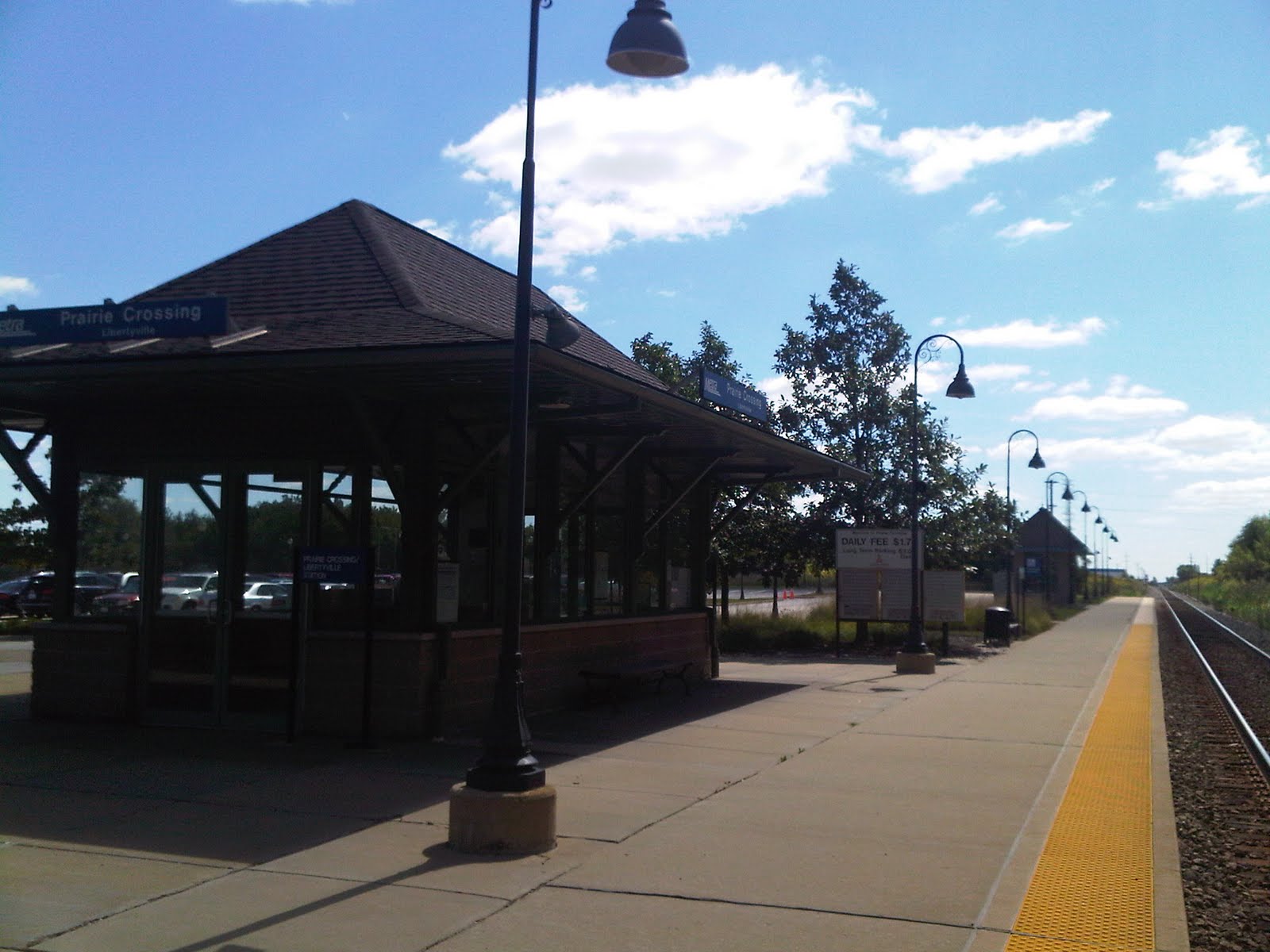
About 40 miles north and west of downtown Chicago, two Metra commuter rail lines come together near Libertyville, Illinois. Although the actual intersection of the routes is a few hundred yards away, both lines serve passengers at stations with the same name – Prairie Crossing, separated by the span of a parking lot. Why is the genesis for two different rail lines serving the same location and how common is such a connection elsewhere in North American passenger rail?

The Milwaukee Road – officially, the Chicago, Milwaukee, St. Paul and Pacific Railroad – first reached the Libertyville area in 1881 as a spur off its main line between Chicago and Milwaukee. Meanwhile, the Wisconsin Central Railway arrived in 1886 on its route between Chicago and Fond du Lac. The railroads competed for the business of not only long-distance passengers and freight on their respective lines, but also for Chicago-bound daily workers, and commuter trains were established on both railroads shortly after their completion. And while intercity passenger traffic dwindled after World War II, both lines maintained healthy commuter traffic through the 1960s and 70s. Indeed, the Chicagoland area was served by a number of railroads operating independent commuter rail operations as late as the 1980s.

Concerned about the loss of vital commuter rail service should the railroads abandon their operations, the Regional Transportation Authority (RTA) was formed in 1974 to coordinate not only commuter rail service (Metra), but also the Chicago Transit Authority (CTA) and the suburban Pace bus system. Gradually, it assumed control of the commuter operations of the various railroads into a unified network, including the Milwaukee Road's route to Fox Lake, Ill., and the Wisconsin Central's line to Antioch, Ill., both of which served independent stations in Libertyville. Beyond ensuring continued service on these lines and purchasing new locomotives and railcars, it also sought to improve connections between its routes where possible. One such connection became the jointly named stations that exist today at Prairie Crossing, although both lines continue to serve their respective Libertyville stations.

Today's Milwaukee District/North line service marks the previous Milwaukee Road operation as it arches northwest from Chicago's Union Station through communities such as Glenview and Northbrook through Prairie Crossing to reach the peninsula community of Fox Lake. At the same time, the current North Central Service retraces the Wisconsin Central route south-by-southeast from Antioch to Prairie Crossing and continuing through Buffalo Grove and Rosemont before linking up with the Milwaukee District/West line at Franklin Park to reach Union Station. The Milwaukee District/North operation carries more than 25,000 riders each day while the North Central Service moves another 5,600. Interestingly, the ownership of the lines has evolved into control by two Canadian-based freight operators, the Canadian Pacific and Canadian National, respectively.
Metra Milwaukee District North train #2134 approaching Prairie Crossing
Prairie Crossing station on North Central Service line
As distinct as the story of Prairie Crossing may be, its not unique in North America, as railroads frequently constructed competing lines for commuter traffic. In Chicagoland itself, today's Metra Heritage Corridor and Rock Island District lines both meet in Joliet, reflecting the interests of the preceding Alton and Chicago, Rock Island & Pacific (commonly known as the Rock Island) railroads. Meanwhile, Maryland's commuter rail service MARC operates parallel routes between Washington, D.C. and Baltimore – its Penn and Camden lines, owing their development to the Pennsylvania and Baltimore & Ohio railroads, respectively – and in the Boston region, the Massachusetts Bay Transportation Authority's Providence/Stoughton and Franklin lines serve nearby but not completely connecting stations at Readville. Unlike the competition-fueled lines in other areas, however, both routes reaching Readville were built by the New York, New Haven & Hartford Railroad.

Elsewhere, Montreal's Agence Metropolitaine de Transport (AMT) finds its Deux Montagnes and Blainville lines passing each other, but not connecting near Canora – again reflecting the battle between CN and CP – while the Chestnut Hill East and West Regional Rail lines of the Southeastern Pennsylvania Public Transportation Authority (SEPTA) terminate within blocks of each other, accounting for the competition between the Reading and Pennsylvania railroads for Chestnut Hill-Philadelphia commuters.

Although new passenger rail services – including high-speed, intercity and commuter modes – will be made available over coming years, its unlikely that any will offer the redundancy of competing routes since they will be made possible by public investment. In the meantime, rail passengers will continue to use these holdovers from the halcyon days of railroading, when competitors laid down tracks within sight of each other and mobilized communities in the process.
Milwaukee District North train 2113

North Central Service Prairie Crossing Depot and Platform
Crossover between Milwaukee District North and North Central Service routes marked by the signal in the distance.
North Central Service trackage across the prairie from the Milwaukee North District platform.

Long-Distance Dining


“It’s not even food, if I understand the meaning of the word.”

CHICAGO UNION STATION, Ill. -- That’s how Anthony Hopkins’ Hanibal Lechter sardonically described the state of airline food in “Hannibal,” the 2001 sequel to “The Silence of the Lambs.” And while the culinary opinions of a fictional cannibal might be just a bit harsh a commentary on how people eat while traveling these days, there is no doubt the quality and intention of meals onboard many vehicles has transitioned substantially from the days of china and fine linens aboard a Pan Am jetliner, where food service wasn’t justified as a money-making enterprise, but rather a way to attract passengers. And, to be fair, the microwaved cheeseburgers and soggy Danish available on most Amtrak regional and corridor trains is not what most diners would consider haute cuisine.

However, one holdover from the nostalgic days of onboard dining are the dining cars still found on the long-distance trains of Amtrak and VIA Rail in Canada. On trains longer than 3 or 4 hours, a full-service dining car is included in the train consist. Here you’ll find sit-down, multiple course offering with wait staff, made-to-order options, adult beverages, and desserts. Adding to the restaurant-on-wheels atmosphere are the reserved table times arranged just after the train departs from its originating terminal.

The motif harks back to the days when dining aboard passenger trains – such as the famous 20th Century Limited of the New York Central or the Royal Blue of the Baltimore & Ohio – offered access to some of the best fare and service in the nation. Executive chef positions for the various railroads were among the most sought-after roles for top cooks and their menus were as exciting and diverse as the regions through which they traveled. The Baltimore & Ohio was known for its extensive use of Cheasapeake Bay oysters, while fresh citrus from California was featured on well-regarded California Zephyr of several railroads, including the Denver & Rio Grande. Moreover, these chefs were among the first adopters of local produce and ingredients – having access to fresh supplies at station stops along the line – a concept that didn’t become prevalent in stationary dining until much later. (For an excellent perspective on Dining on the B&O by Thomas Greco and Karl Spence, please read Christine Pomorski’s review in RAIL #23.)

Certainly, there is no confusing today’s long-distance dining experience with the halcyon days of railroading; meals now are less lavish and more standardized. A New York strip steak might represent the featured entrĂ©e and the butter comes from wrapped packets rather than whipped-up on a plate. But when considering that cooking on a rocking railcar might be among the most challenging platforms in which to prepare food – not to mention the wait staff who deliver it – a fresh-cooked meal can turn a long and winding train trip into a enjoyable way to spend some time.

There’s one last aspect of long-distance train dining that must not go unmentioned. Because the challenge of fixing place settings aboard a moving railcar is daunting, dining car staff seat patrons together to maximize table efficiency. This means that often diners will share a meal with fellow travelers they’ve never met. I find this to be the most rewarding part of long-distance train travel – to share a meal and some conversation with complete strangers. You quickly learn to discuss what you have in common and in an increasingly divided age, it’s a rare opportunity to come together in a respectful and civilized setting. 

Last night, I had the pleasure of dining with Will and Carol of Clinton, Iowa. Will works for a caramel coloring plant and Carol is a teacher. They were visiting friends in New Jersey and returning home to Iowa aboard the Capitol Limited and then Chicago's Metra commuter rail service to Aurora, Ill., before driving the remainder of the trip. We had a great conversation over Will's New York strip, Carol's salmon filet and my 1/4 chicken, before we all couldn't resist the peanut butter-chocolate pie. A good time was had by all.

Tuesday, September 7, 2010

Hitting the Rails...


In just a few hours, I'll climb aboard Amtrak #26 – the 4:05 p.m. departure of the westbound Capitol Limited. I'll be aboard the Capitol the entirety of its trip to Chicago, Ill., scheduled to arrive in the Windy City at 8:45 a.m. tomorrow morning. From there, I'll spend little more than a day in Chicago, exploring some of the railroading nuances there – and a brief trip up to the historic Wrigley Field for a Cubs game – before catching Amtrak's #5, the westbound California Zephyr on Thursday afternoon en route to Denver, Colo., to attend the USA Rail 2010 Conference early next week.

Along the way, you can expect a series of posts not only chronicling my journey, but also some commentary and analysis of some of the interesting elements of long-distance train travel and a few of Chicago's railroading distinctiveness. For instance, I'm planning posts on dining aboard long-distance trains, a visit to Prairie Crossing, Ill., Chicago's four train stations and some background on how trains are named. Some posts might be rather brief on account of travel limitations. Lastly, I'll be liveblogging the USA RAIL 2010 Conference once it gets underway.

Stay tuned...

Thursday, September 2, 2010

Moving Freight & Passengers


In just over a week, experts and professionals in intercity passenger and freight rail will gather in Denver at the USA RAIL 2010 Conference to discuss the direction of railroading in the United States and some of the recent and ongoing legislative and policy activities to support increased high-speed and intercity passenger rail in the nation. A series of speakers and presenters from Amtrak, freight railroads and public agencies will consider topics such as capital and investment, infrastructure needs, intermodalism and other important elements that must combine to form a cohesive approach to the nation's rail network.


The meeting provides a timely forum to discuss the increasing concern that has developed recently about the impact of current and forthcoming high-speed and intercity passenger rail projects will have on the American freight rail network. The number of new corridors that will install true high-speed infrastructure will be limited – likely to those in Florida and California – at least initially. Accordingly, most of the remaining projects will involve some interaction with freight lines.

Freight railroads are nervous after the U.S. Department of Transportation has suggested that they may be liable to reimburse the federal government for upgrades to their infrastructure supported through ARRA and other sources if passenger trains do not achieve pre-agreed upon reliability and performance measures. Moreover, mandates to install positive train control on routes shared with passenger trains stemming from the Passenger Rail Improvement and Investment Act of 2008 have not been matched with public investment to support these technological upgrades.

But, more importantly, as recent analysis from The Economist and Transport Politic suggest, attempts to achieve both significantly improved intercity passenger service and maintain existing freight capacity will be difficult to achieve due to the different operating speeds required by the two modes. Operating passenger trains too slow and freight trains too fast benefits neither sector and wastes the efficiency and revenue centers of both. So, while co-mingling passenger and freight traffic is fiscally possible on routes with fewer than a half-dozen or so daily passenger trips, when passenger frequency increases, significant passenger-only infrastructure is often necessary.

Because of this reality, some observers suggest that a broad effort to improve passenger rail in the United States are futile because most will not be able to achieve true high-speed status and others claim it will impose substantial disadvantages to the freight network, which is, indeed, a well-established, economically-successful and environmentally-friendly way of moving goods and materials that is unmatched elsewhere in the world. It's also one for which the United States receives too little credit by international and domestic commentators.

However, to suggest such a zero-sum game – to build massively expensive high-speed infrastructure or essentially maintain the status quo of freight traffic dominance – as the only possible outcome is a shortsighted view of policy-making. Indeed, in some cases, only incremental increases will be possible, like the new services being planned for Ohio's 3-C corridor or between Milwaukee and Madison. However, those projects also represent restoration of service absent for more than three decades, so any increase is an infinite upgrade. And the true high-speed projects in California and Florida will demonstrate the potential of the technology, which can be adapted to additional corridors later. But there will still be opportunities for conventional – non high-speed – services that can benefit both intercity passenger and freight interests. In fact, these types of efforts have already found a model for success at the commuter rail level.

Commuter rail systems such as the Trinity Railway Express between Dallas and Fort Worth, the Caltrain service between San Francisco and San Jose, the New Mexico Rail Runner serving Albuquerque and Santa Fe, and the Utah Transit Authority's Front Runner between Ogden and Salt Lake City all represent conventional rail applications that offer outstanding frequency while also co-mingling with freight traffic or along dedicated tracks along freight corridors. Each service operates at least a dozen roundtrips on weekdays in multiple directions with off-peak trips at midday or in the evenings. Meanwhile, their tracks are available to accommodate freight traffic either at the same time or at segregated periods, maximizing the efficiency and functionality of these corridors. The key similarity among these systems in various parts of the country is public control over the rail infrastructure, meaning their commuter trains are not delayed by freight trains with greater priority. At the same time, the State of North Carolina owns the railroad that connects its major cities of Raleigh-Durham, Greensboro and Charlotte, which has allowed North Carolina to add frequencies, train speeds and reliability to its state-sponsored Amtrak trains such as the Piedmont and Carolinian.

In this framework, projects supported by ARRA in Illinois and Virginia will add dedicated track to support increased frequency and speed, while Oregon and Washington as well as New York are planning similar improvements to their existing Amtrak services, the Cascades and Empire Service, respectively. These efforts – while certainly not instituting high-speed rail – will offer greatly enhanced intercity passenger rail service while also improving the infrastructure available to freight trains. It is an important first step to make to help larger sections of our society become familiar with intercity rail travel before the significant investment needed for high-speed projects is secured.

The perfect is not the enemy of the good, and this notion must be continually re-emphasized as the nation undertakes its reinvestment and revitalization of its intercity passenger rail network.